
Survival Strength – Three Essential Exercises for Life on the Go
Introduction
I was inspired to write this article by a Japanese executive who believed that a “survivor’s guide” to exercise would be invaluable for busy professionals—especially those working 90-hour weeks and constantly traveling. After more than 40 years in business, this gentleman, like many of my clients, realized that time is life’s ultimate scarcity.
No matter how packed your schedule is, I always recommend making time to exercise. Even on days when your calendar is wall-to-wall or you’re flying halfway across the globe for a two-day trip, it’s still possible—and even more important—to carve out a few minutes for movement. If you’re up at 4:30 a.m. and not back in bed until 11 p.m., getting to the gym may be unrealistic, but that doesn’t mean you can’t exercise. In fact, these are the days when you should prioritize it even more.
Look for “lost time” throughout your day—waiting for a taxi, pre-boarding a flight, standing in line at the train station, or even waiting on hold if you’re still doing lots of business via phone. These unexpected windows are perfect opportunities to fit in quick “survival strength” exercises that help you maintain your health and fitness, wherever your work takes you.
|
Requirements for these exercises: |
|---|
|
• No equipment needed • Can be done in a suit without getting too sweaty • Focus on getting them done (“THAT” > “HOW”)—don’t worry about perfect form, just make it happen • Total body balance via one lower body movement, one upper body pushing movement, and one upper body pulling movement |
Lunges or step-ups
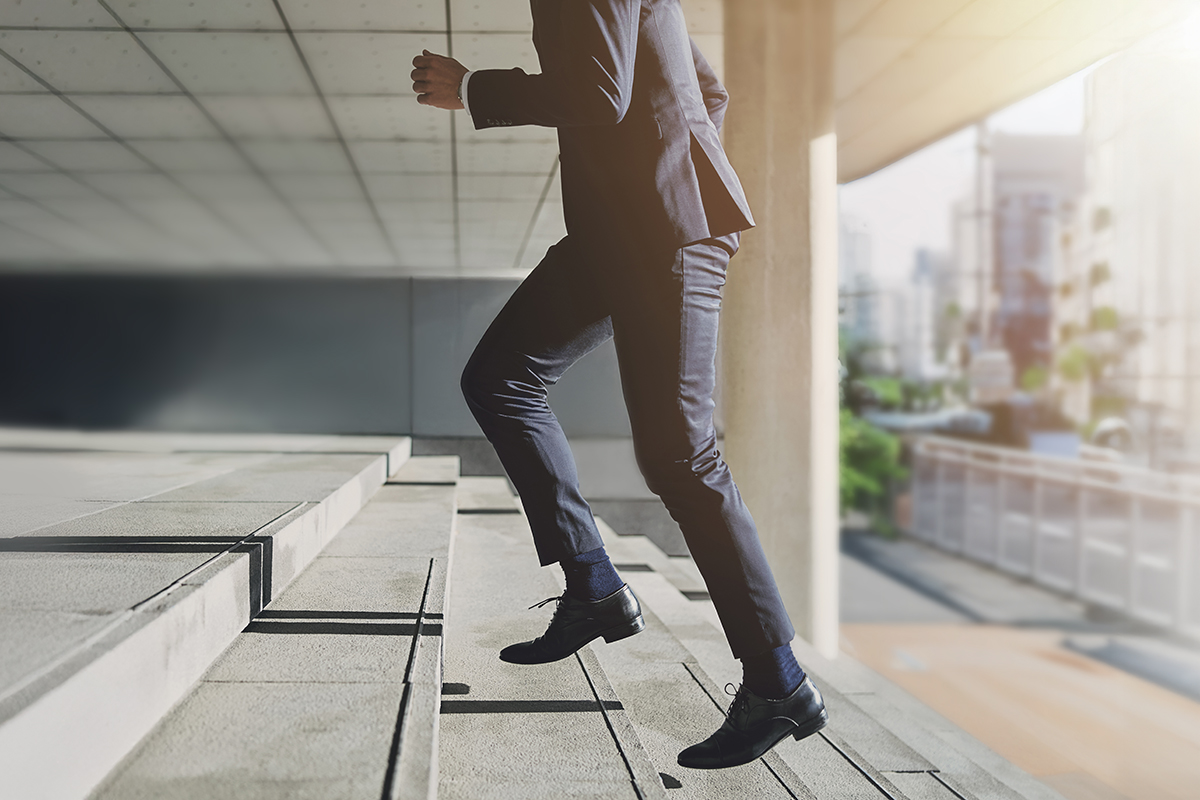
Last autumn in Tokyo, on a fairly normal day for me, jumping between airports, train stations, and darting to lunch and dinner meetings, I counted over 300 stairs climbed in a single day (yes, I actually counted!). I didn’t go out of my way to find extra stairs—just made a conscious choice to take them whenever possible and watched the results happen.
This is something any busy executive or entrepreneur can replicate in a big city with major transit hubs. The point isn’t that I did it, but that you can too—with just a bit of intention. Consider it your “exercise superhero” move in disguise.
Lunges (or step ups, depending on your perspective) are a hidden gem: nobody bats an eye if you walk up two stairs at a time at the train station. That removes the awkwardness some people feel about doing “obvious exercise” in public. Lunges are easy to integrate into your day with zero extra effort, thanks to the endless transport hubs you’ll encounter—whether your trip is two days or twenty-two.
Whenever you take two or three steps at once, because of the amount of leg movement required, you’re performing a lunging motion – an essential human movement. With a busy day on the road, you can easily add 100 stairs to your routine just by choosing stairs at train stations, airports, and hotels. With a little conscious thought—“I’ll take the stairs”—you’ll engage your entire lower body, plus your heart and lungs, as you lunge your way up.
The prayer press
Put your hands together in a “prayer” position and push as hard as you can. As I mentioned in the intro, it’s more important that you actually do this exercise than worry about perfect form. If you’re feeling ambitious, you can adjust the height of your hands on your torso to target different muscles. This move works your chest, shoulders, and some of those deeper stabilizers. These muscles are built for power, so you’ll usually feel them fatigue quickly—which is great for your schedule, since you won’t need to hold the prayer press for more than 60 seconds (unless you’re secretly Superman under that suit).
One key tip: give it your all. It’s easy to go through the motions and miss out on the benefits, so really push your hands together HARD. You can sneak this exercise into your daily routine—standing, sitting, whenever you have a moment. If you manage to do this five or more times a day with true maximum effort, expect some muscle soreness tomorrow. That’s a win for you, your schedule, and your next personal training session, knowing you haven’t missed a beat. I’ve made a video demonstrating how to perform the prayer press below to help you out even more!
Scapular retraction
The other day, I caught a glimpse of my posture in the window reflection while working at my desk– my desktop screen pulling my head and body forward like an ogre hunched over his fire in a cave. That moment set my 2026 New Year’s Resolution: I’m back to standing at my desk, and my posture thanks me. I feel like a million bucks.
We all spend too much time sitting, pulled forward by our little blue light screens and devices. Constant engagement with our technology has made it harder for most of us to consciously activate the mid-back muscles that keep us upright. Even regular gym-goers often neglect these “invisible” postural muscles in favor of the “beach muscles” we see in the mirror. Trust me—your future self will thank you for the effort of correcting this. You might even surprise (and inspire!) your physio or trainer at your next check-in when your posture is better than theirs!
For this exercise, stand tall and pull your shoulder blades together behind your back—simple as that. Imagine pinching my finger between your shoulder blades. If you struggle with this, you’re not alone. Even as someone who lives and breathes exercise like me, it takes active work to maintain this ability. Try sitting down, gripping your chair’s seat, and attempting to pull your arms behind you (they won’t move, and that’s the point!). Keep practicing consistently, and you’ll improve. Again, I’ve given you a quick exercise demonstration in the video above.
Conclusion
As part of this article I’ve provided two exercise walk through videos, with tips I usually reserve for clients who train with me. If you found these valuable, or if this article inspired you to become an “exercise survivalist” when your schedule is chaos, I’d love to hear from you!
My mission at Summit Performance is to help the world’s busiest and highest performing individuals stay strong, healthy, and energized—no matter where the world takes them. If you’re looking to make your health & fitness goals a reality for 2026 with a personal trainer who comes to you—on your schedule, wherever you are in the world, you can reach me here on my website, here on LinkedIn, or in person in Japan in April – catch me if you can!
About the writer
Mike Slomczewski, MSc, PT, CSCS is a physiotherapist, strength and conditioning specialist and the owner of Summit Performance. He serves executives, business owners, busy professionals and unique solo athletes with full-service travel health and fitness services.
You can book a Discovery Call with Mike here: www.summit.fit/discovery-call
Learn more about Summit Performance: www.summit.fit