
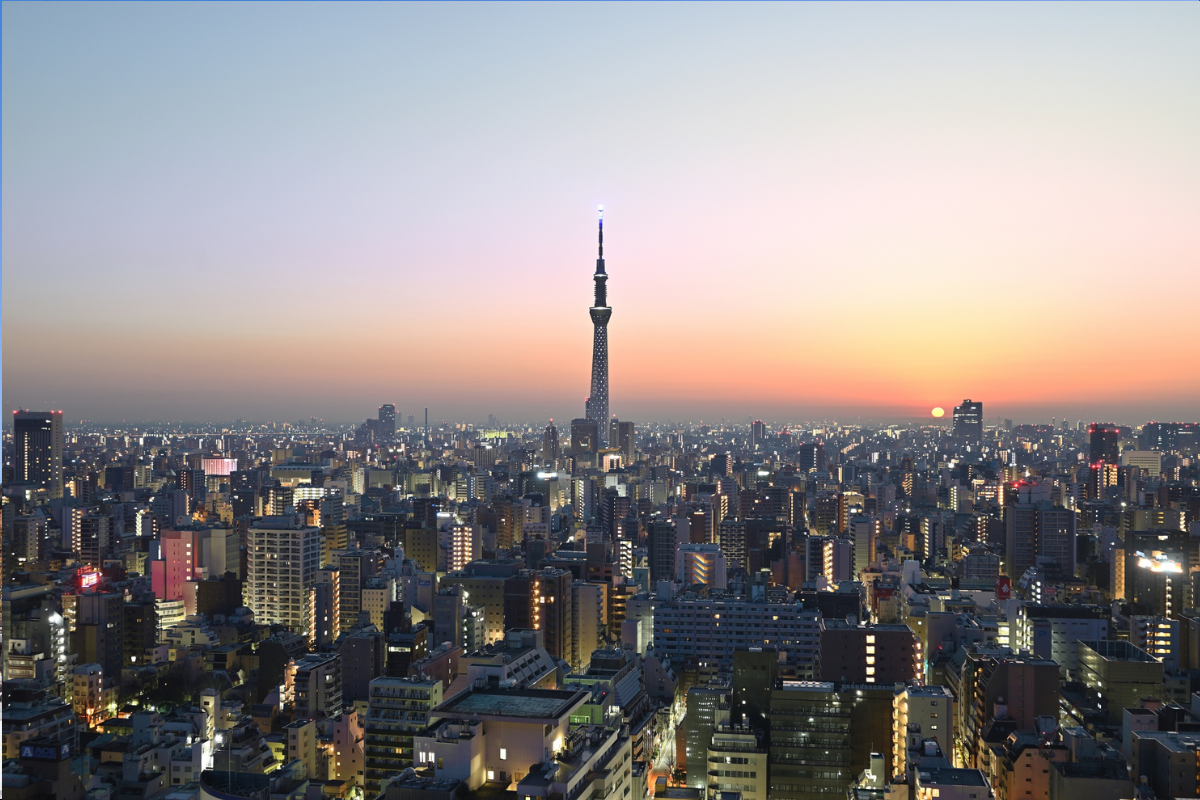
Major Redevelopment Projects Shaping Tokyo Through 2035
Tokyo’s urban evolution rarely arrives through sudden disruption. Instead, it advances through long-term planning, coordinated infrastructure investment and carefully phased redevelopment that reshapes entire districts rather than individual buildings.
As Japan moves deeper into the second half of the 2020s, a new wave of large-scale redevelopment projects is redefining how people live, work and move across Tokyo and Greater Tokyo. Led by established developers, rail operators and public authorities, these projects prioritize durability, connectivity and institutional continuity over short-term momentum.
What distinguishes Tokyo globally is not only the scale of redevelopment but its ability to absorb growth without extreme price volatility. The metropolitan area consistently delivers a volume of new housing unmatched by other global cities, supported by rail-centric planning and flexible zoning.
Below is an overview of the most significant publicly disclosed redevelopment projects shaping Tokyo’s next decade, based strictly on verifiable sources and using AI / concept images.
Tokyo Torch (Tokiwa-bashi, Tokyo Station Area)
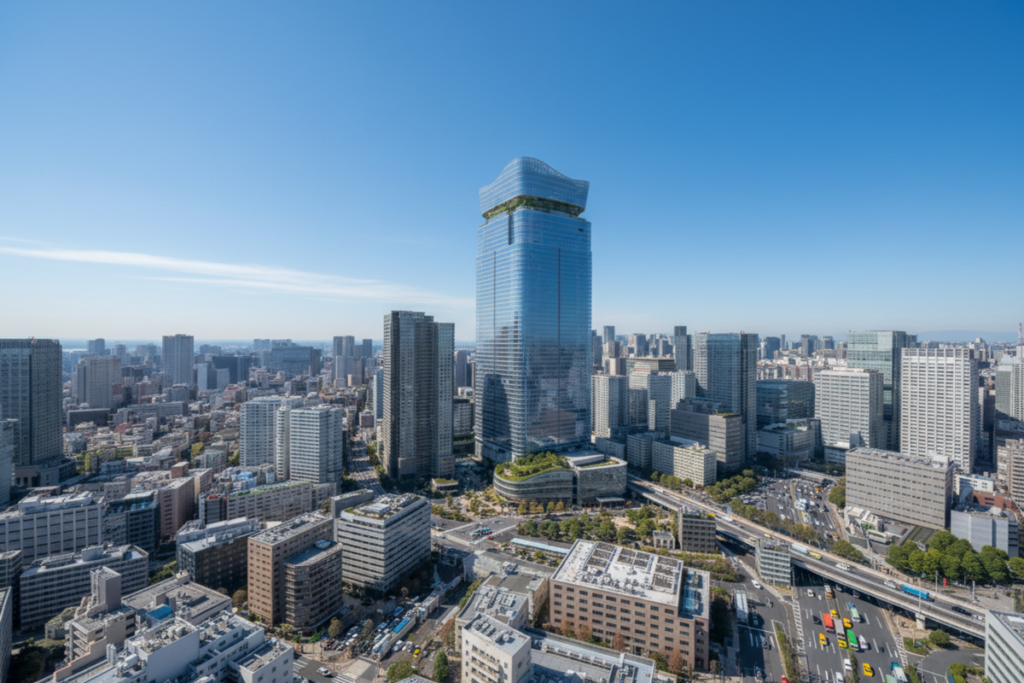
Developer: Mitsubishi Estate
Location: Tokiwa-bashi, Chiyoda Ward
Tokyo Torch extends the Marunouchi–Otemachi business axis toward Tokiwa-bashi, reinforcing Tokyo Station’s role as the nation’s primary economic gateway. The centerpiece, Torch Tower, is scheduled for completion around 2028 and is expected to reach approximately 385 meters, becoming Japan’s tallest building.
Beyond height, the project emphasizes pedestrian permeability, open public space and improved east–west connectivity across the station area. Rather than functioning as a closed office enclave, Tokyo Torch is designed as a mixed-use district supporting finance, international business and urban circulation at a metropolitan scale.
Takanawa Gateway City (Shinagawa)
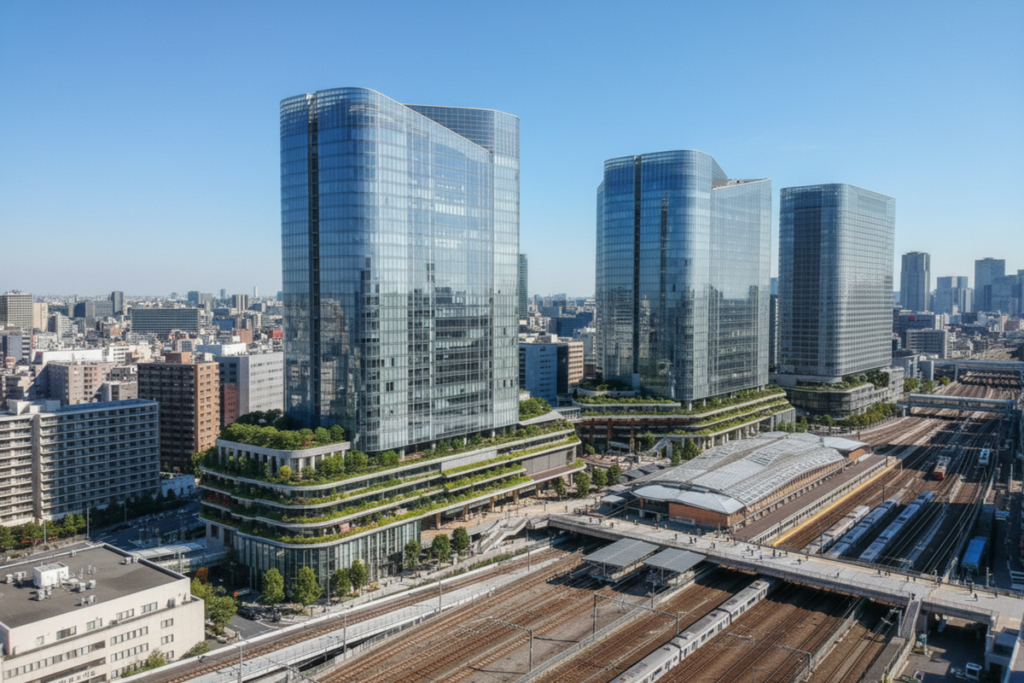
Developer and Operator: East Japan Railway Company
Location: Takanawa, Minato Ward
Takanawa Gateway City is a district-scale redevelopment anchored by Takanawa Gateway Station on the Yamanote Line. The project integrates offices, residences, hotels, retail and MICE functions directly into a next-generation transport hub.
Positioned between Shinagawa and central Tokyo, the area benefits from direct access to Haneda Airport and major intercity rail lines. The redevelopment emphasizes smart-city experimentation, sustainability and flexible urban systems, positioning the district as a long-term innovation corridor rather than a conventional commuter zone.
Shibuya Station Area Redevelopment
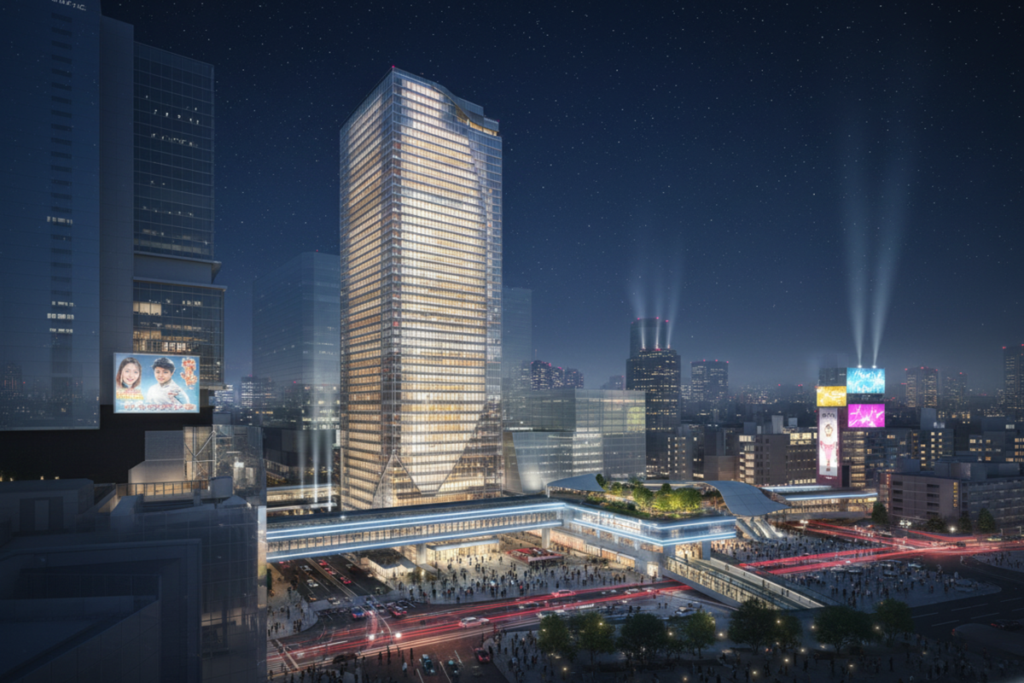
Developers: Tokyu Corporation and partners
Location: Shibuya Ward
The Shibuya Station Area Redevelopment represents one of Tokyo’s most complex urban transformations, restructuring rail infrastructure, pedestrian circulation and vertical mixed-use development around one of the city’s busiest transport hubs.
The multi-phase project includes new station buildings, office towers, cultural facilities and extensive public space improvements. Its long-term objective is not only capacity expansion but the reorganization of movement patterns across rail lines, streets and elevated walkways in a district defined by constant foot traffic.
Nihonbashi 1-Chome Redevelopment
Developers:
Mitsui Fudosan
Nomura Real Estate
Location: Nihonbashi, Chuo Ward
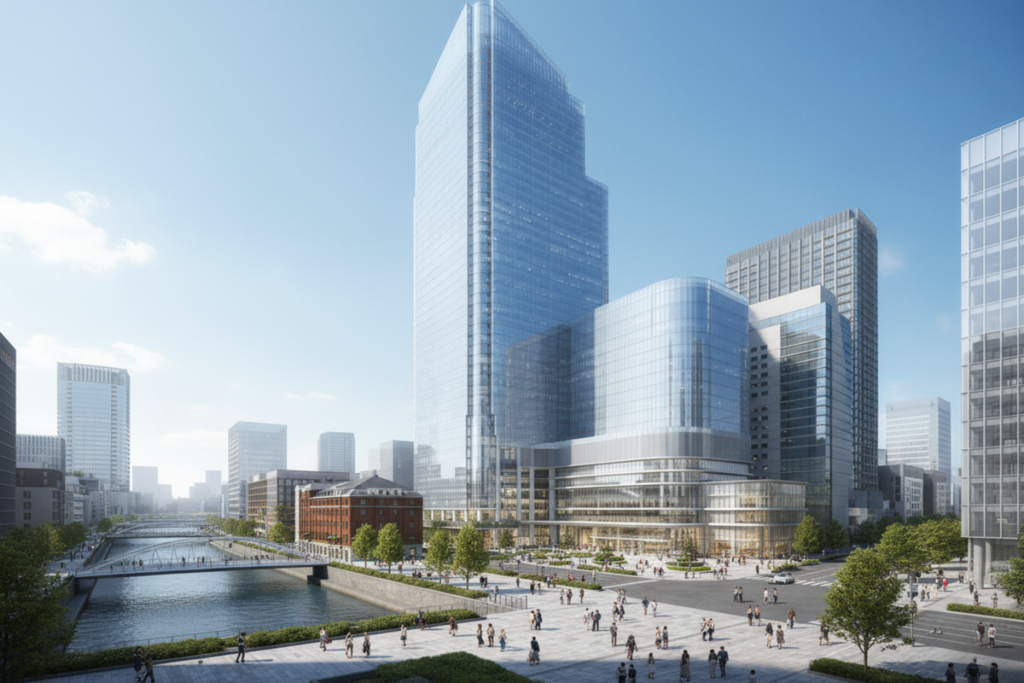
The Nihonbashi 1-Chome Redevelopment reinforces Nihonbashi’s identity as one of Tokyo’s most institutionally focused commercial districts. Jointly developed by Mitsui Fudosan and Nomura Real Estate, the project introduces high-rise mixed-use buildings, including a tower planned to reach approximately 284 meters.
Nihonbashi has long served as a center for finance, commerce and corporate headquarters, and the redevelopment reflects a measured approach to modernization. Office space remains the dominant function, supported by hotel and retail components that serve business users and international visitors.
Rather than pursuing a lifestyle-oriented repositioning, the project prioritizes infrastructure renewal, disaster resilience and long-term functionality. Pedestrian connectivity and efficient land use are central to the design, ensuring continuity with the surrounding district. As Tokyo’s core continues to densify, Nihonbashi 1-Chome stands as a model of conservative, institution-led redevelopment focused on stability and longevity.
Tsukiji District Redevelopment (Former Market Site)
Lead Authority: Tokyo Metropolitan Government
Location: Tsukiji, Chuo Ward
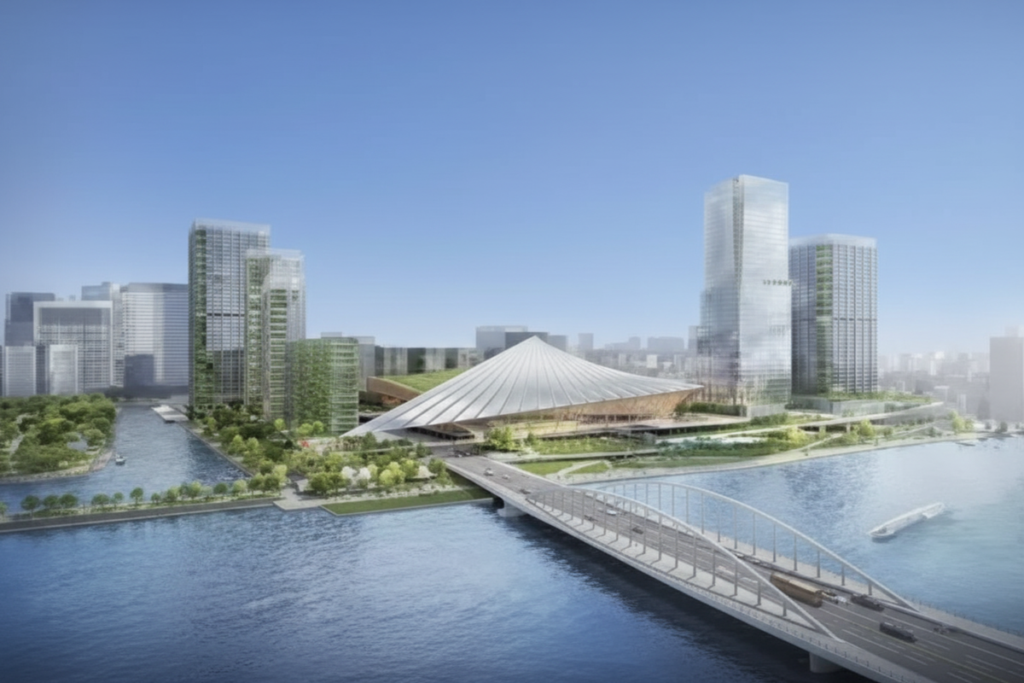
The former Tsukiji Market site represents one of the last large-scale redevelopment opportunities in central Tokyo. Located between Ginza and Tokyo Bay, the site occupies a strategic position connecting commercial, cultural and waterfront districts.
Led by the Tokyo Metropolitan Government, redevelopment plans emphasize metropolitan-scale mixed use rather than high-density residential development. The vision focuses on creating a district capable of accommodating international events, business functions, cultural institutions and large public spaces.
Unlike residential-led waterfront projects elsewhere in Tokyo Bay, Tsukiji is positioned as a civic and commercial node with long-term flexibility. Its scale allows for phased development that can adapt to future economic and social needs. As Tokyo evolves beyond its traditional core, the Tsukiji redevelopment is expected to play a critical role in shaping the next phase of the city’s central urban structure.
Roppongi 5-Chome West Project
Developer: Mori Building
Location: Minato Ward
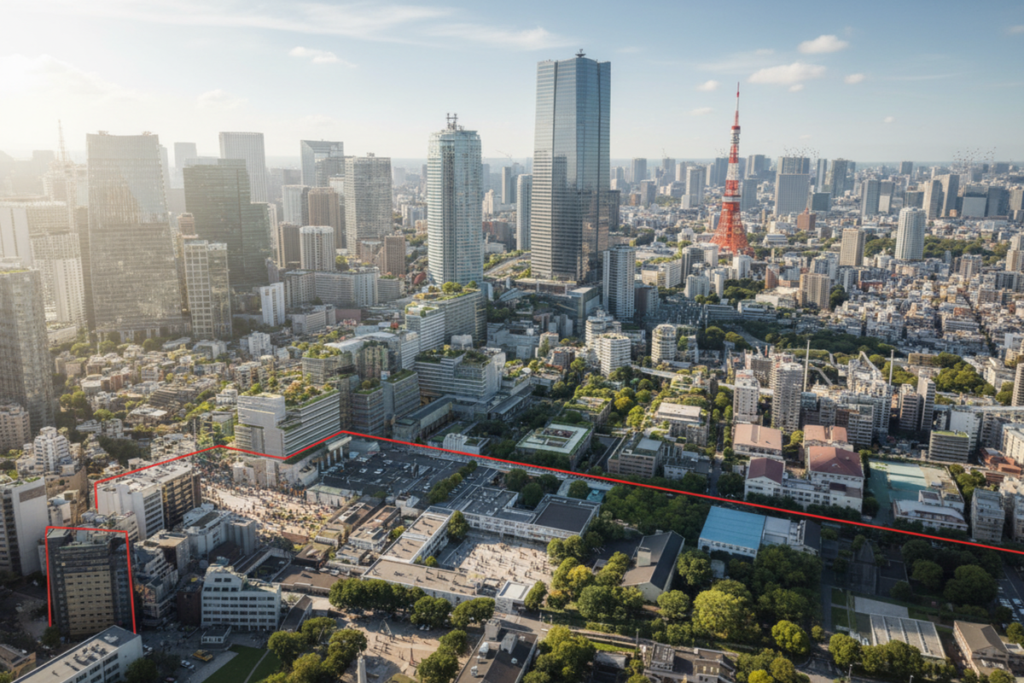
The Roppongi 5-Chome West Project continues Mori Building’s long-term strategy of area-based redevelopment in Minato Ward. Planned as a large-scale mixed-use district, the project integrates offices, residences, hotels and cultural facilities with upgraded public space and infrastructure.
Rather than competing with nearby Roppongi Hills or Azabudai Hills, the development reinforces a broader urban ecosystem focused on international business, embassies and cultural institutions.
Construction Costs and Project Risk
Rising construction costs represent a growing constraint across all major redevelopment projects in Japan. Material price increases, labor shortages and longer construction timelines have already prompted design revisions, phasing adjustments and cost reassessments across the industry.
While most of the projects listed above are backed by large developers or public institutions with long planning horizons, sustained cost inflation may affect completion schedules, final specifications or project phasing. However, outright cancellation remains unlikely for district-scale developments tied to transport infrastructure and long-term urban policy.
FAQ: Tokyo Redevelopment Through 2035
Why does Tokyo focus on district-scale redevelopment instead of individual buildings?
Tokyo prioritizes district-scale redevelopment to improve transport connectivity, disaster resilience and infrastructure efficiency at the neighborhood level. Redeveloping entire areas allows rail hubs, offices, housing and public space to function as an integrated system rather than isolated assets.
How do major redevelopment projects affect Tokyo real estate prices?
Large-scale redevelopment in Tokyo tends to support long-term price stability rather than sharp inflation. Continuous housing supply, strong rail access and phased delivery help absorb demand across the metropolitan area without creating extreme shortages seen in other global cities.
Who leads Tokyo’s largest redevelopment projects?
Tokyo’s major redevelopment projects are led by long-established developers, rail operators and public institutions. These include private developers, railway companies and metropolitan authorities that operate on decades-long planning horizons rather than short-term market cycles.
Will rising construction costs delay Tokyo’s redevelopment projects?
Rising construction costs may affect project phasing, specifications or completion timelines. However, most district-scale redevelopments tied to transport infrastructure and public policy are unlikely to be canceled due to their strategic importance and long-term institutional backing.
Why can Tokyo add so much new housing without destabilizing the market?
Tokyo combines flexible zoning, rail-centered urban planning and continuous redevelopment across both central and suburban areas. This allows the city to deliver a high volume of new housing every year, helping balance supply and demand despite population density and economic concentration.
All images are conceptual / AI-generated for illustrative purposes only.
To stay updated on more insights about life and family in Japan, subscribe to the GoConnect newsletter.
If you enjoyed this article, please let us know and share your thoughts at hello@goconnect.jp.