
Japanese Photographer Stands Out at Wildlife Photographer of the Year Awards
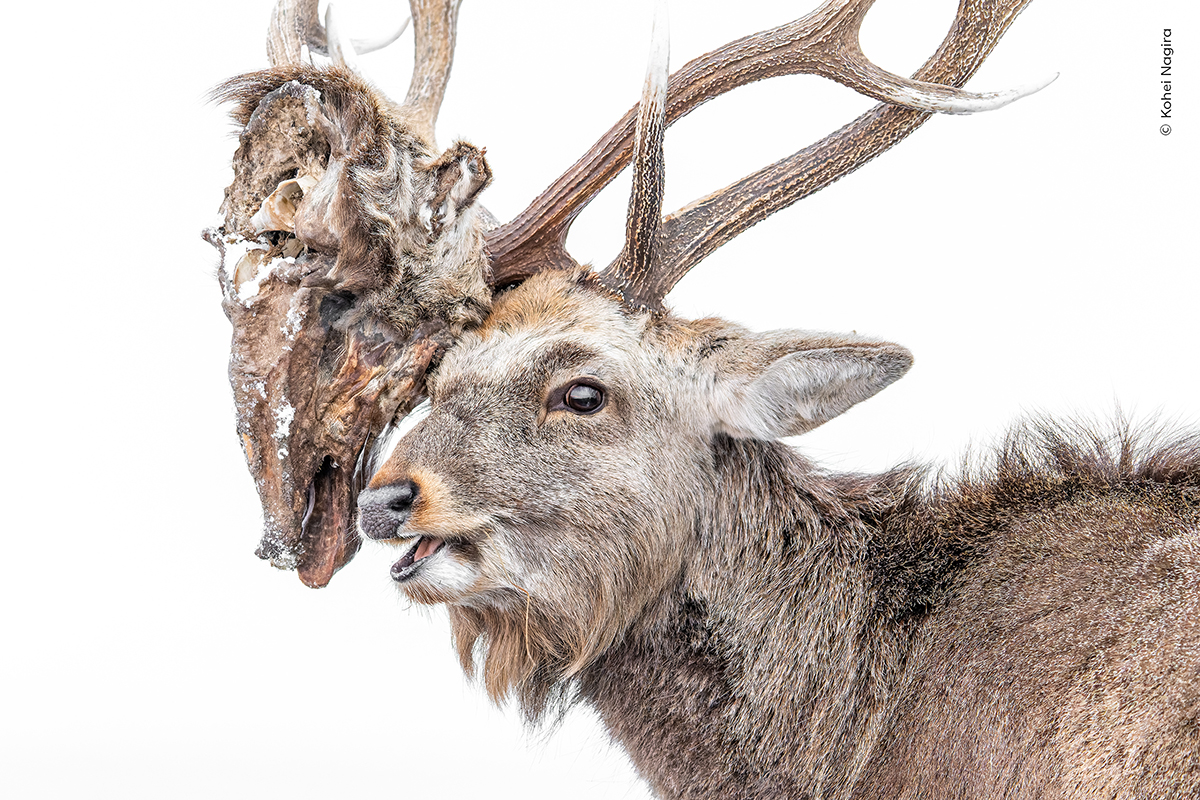
“Never-ending Struggle” — Kohei Nagira’s photograph of a sika deer (above) carrying the interlocked severed head of a rival male that had died after their battle — was highly commended by the Natural History Museum, London’s prestigious annual awards.
“In autumn, male sika deer fight over females by clashing their antlers. This deer won the fight, but their antlers became tightly locked and wouldn’t come apart. A local fisherman says the deer dragged the whole body for several days before finally tearing off its head. Nagira observed the deer on Notsuke Peninsula in Hokkaido, Japan, from late November 2020 to April 2021. It was living alone, yet it continued to forage for grass and branches and managed to survive the winter. The image shows the intertwined nature of life and death to its viewers.”
Following a record-breaking 85,917 votes, the museum’s Wildlife Photographer of the Year Nuveen People’s Choice Award 2026 announced Austrian photographer Josef Stefan as the winner for his photograph of a playful lynx (below).
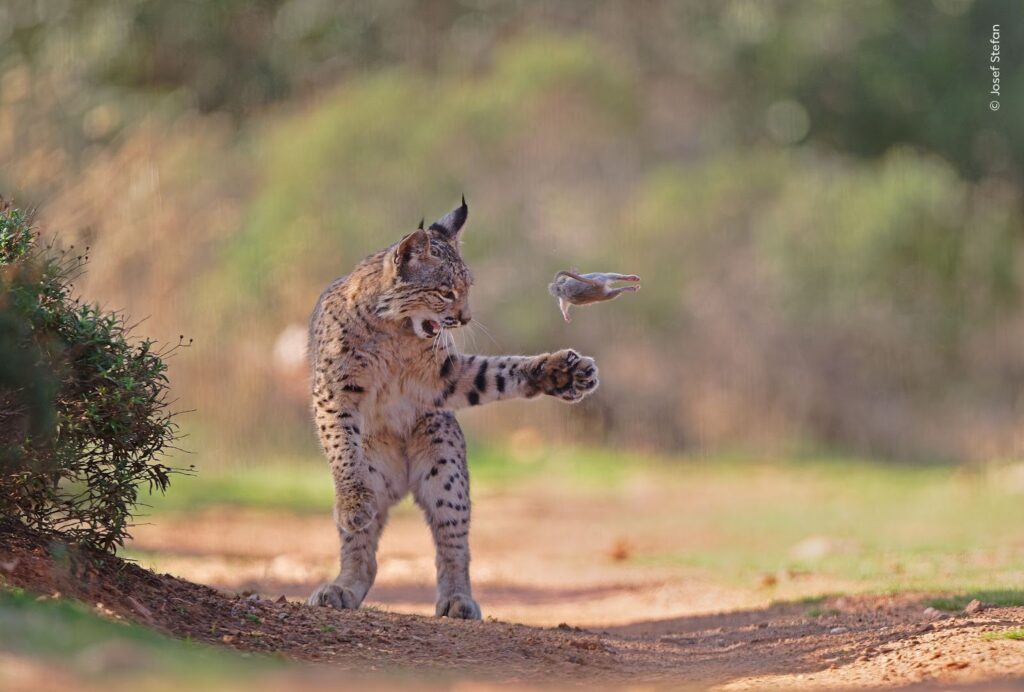
Stefan’s “Flying Rodent” secured the top spot against 23 other shortlisted photographs, chosen from among 60,636 entries from 113 countries and territories, in addition to the 100 winning images announced in October 2025. The images were selected by an international judging panel of photography, wildlife, conservation and science experts, as well as the Natural History Museum, London.
“Stefan was delighted when the opportunity arose to spend two weeks observing lynx from a hide at Torre de Juan Abad, Ciudad Real, Spain. His winning image depicts a young lynx playfully throwing a rodent into the air before killing and devouring it, which is common behavior for the species. The whole game lasted 20 minutes before the lynx got bored, taking the rodent behind a bush to consume it.”
Stefan said: “The journey to take this image was more than just another photographic adventure, it was the pursuit of a dream that had been with me for years encountering the Iberian lynx, one of the rarest and most endangered wild cats in the world. In the early 2000s, this species was on the brink of extinction. Today, there are now over 2,000 thanks to consistent conservation efforts. The Iberian lynx is a living symbol of hope, showing what can happen when we take responsibility, act consciously and focus our attention where it’s most needed. Winning this award and being able to platform this message is the highlight of my 30 years as a nature photographer.”
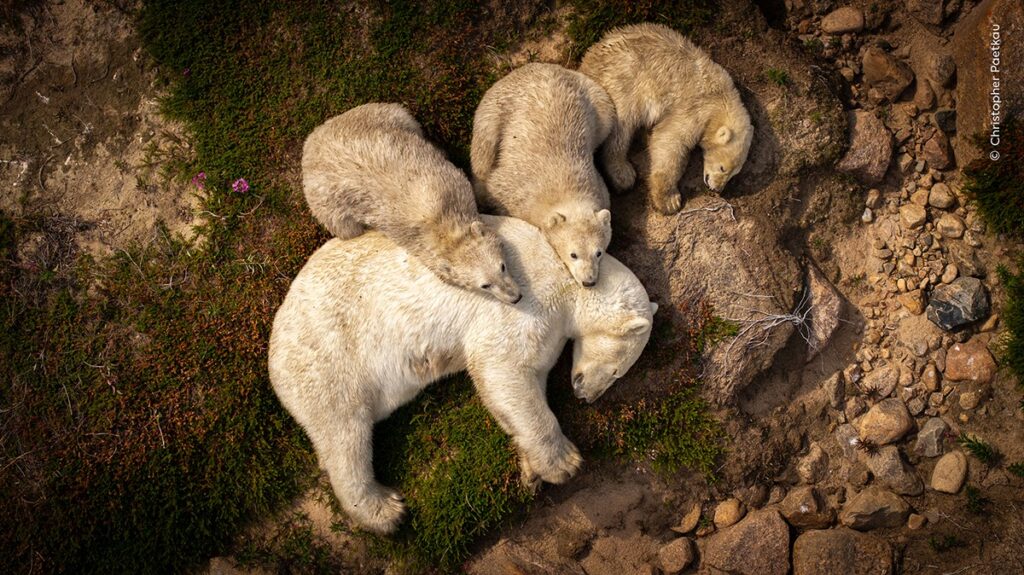
“Family Rest” depicts a mother polar bear and her three cubs pausing serenely in the summer heat on the Hudson Bay coast in Canada, taken by Christopher Paetkau (above). In the midst of climate change, this type of scene grows rarer by the day.
“The sun is high, the land wide and open. The polar bears rest after their long journey north along the Hudson Bay coast. Shrinking sea ice is making it harder for polar bears to hunt and find food to survive in summer. This is a story of endurance and a fleeting moment of hope in a world where survival is anything but certain.”
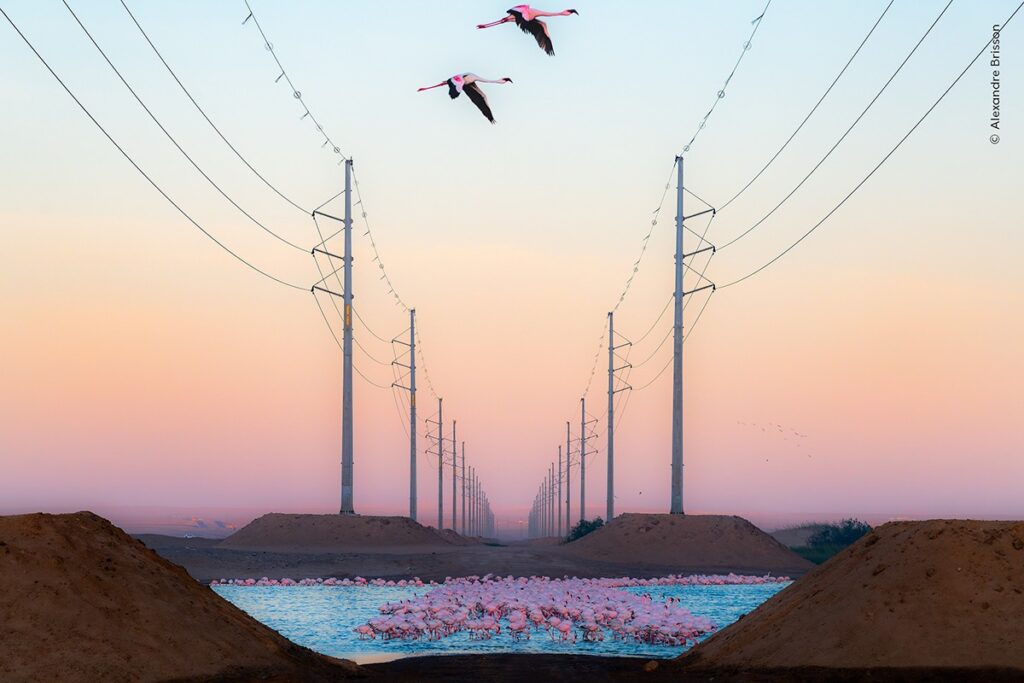
“Beauty Against the Beast”: Another highly commended image that also impressed wildlife lovers across the globe was flamingos standing out against a stark industrial backdrop of power lines in Walvis Bay, Namibia, by Alexandre Brisson. A group of flamingos stands out against a stark industrial backdrop of power lines. After a 10-hour drive, Alexandre arrived at this bird sanctuary in Walvis Bay, Namibia, just as the sun was setting.
“The smell from a nearby open-air dump was overwhelming, a sharp contrast to the beauty of the lesser flamingos. He waited for the right moment, hoping to capture them flying between the power lines. When two of them finally took off, their graceful flight stood out against the backdrop. The image shows how even spaces meant to protect wildlife carry the signs of human expansion.”
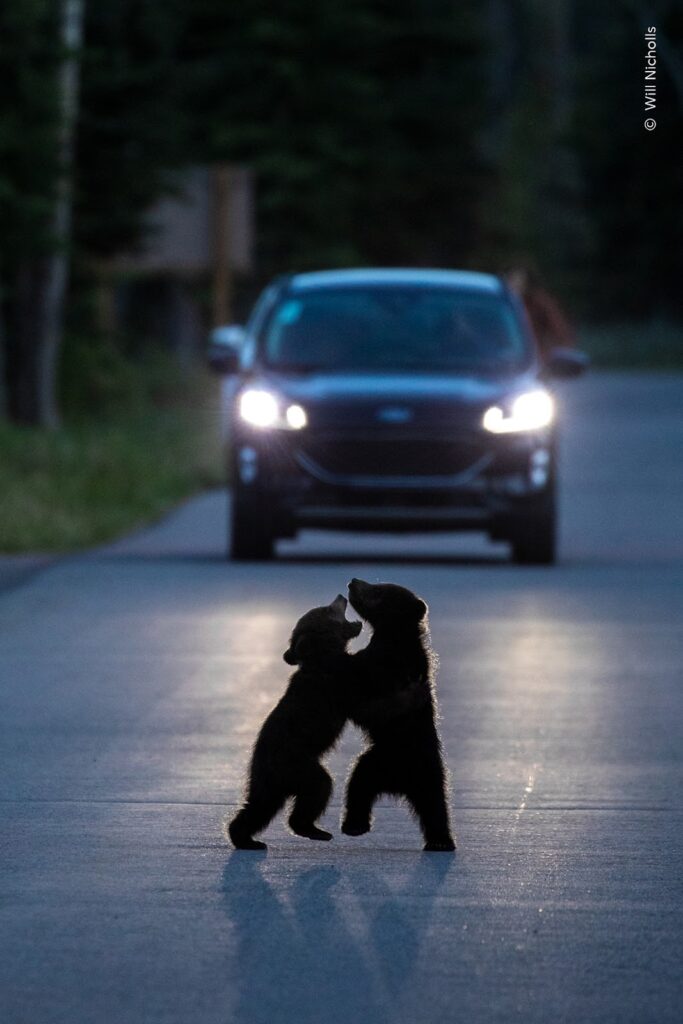
“Dancing in the Headlights”: Will Nicholls’ image of a silhouetted pair of young bear cubs rearing up and play-fighting in the middle of a quiet road in Jasper National Park, Canada, was also one of four runners-up. “Bears are a fairly frequent sight in Jasper National Park. But cubs are rarer, as mothers tend to keep them away from any threats. It’s an enchanting moment, but also a risky one for the playful young cubs silhouetted against the glow of car headlights. Framed by the darkness of the surrounding forest, the scene took on an almost theatrical feel for Will. When the lights aligned, he knew it was the image he was after.”
Dr. Douglas Gurr, director of the Natural History Museum, London, said: “It’s been wonderful to see all the votes coming in to choose the photograph set for display in our flagship exhibition here at the Natural History Museum. Whether showcasing fascinating behavior or platforming a powerful story, this year’s selection of images was truly exceptional.”
The winner and runners-up will be showcased on the voting screens in the Wildlife Photographer of the Year exhibition at the Natural History Museum, London, until July 12. “Flying Rodent” will also be featured on the gallery wall alongside the winning images in the main competition.
About Wildlife Photographer of the Year
Now in its 61st year, Wildlife Photographer of the Year is the Natural History Museum, London’s global platform for the world’s best nature photography and wildlife photojournalism. This annual competition, receiving more than 60,000 entries, is open to photographers of all ages, nationalities and experience levels.
With touring exhibitions and outreach activities engaging millions around the globe every year, they invite ever more people to celebrate and advocate for the natural world. This year, the museum is touring the UK, Australia, Canada, Denmark, Germany, Italy, The Netherlands, Switzerland and the United Arab Emirates, with more locations to be confirmed.
About the Natural History Museum, London
The Natural History Museum is a world-leading scientific research center and the UK’s number one visitor attraction that welcomes more than 7 million people to blockbuster exhibitions, galleries and gardens, and 400 scientists are finding solutions to the planetary emergency — from reversing biodiversity loss to resourcing the green economy. With more than 80 million specimens, spanning 4.5 billion years, the breadth and depth of the Museum’s collection make it the most important of its kind in the world. Through its NHM150 campaign, it is raising an additional £150 million to transform its iconic building and meet its mission of creating more than 100 million advocates for the planet by 2031 — the museum’s 150th anniversary.
To stay updated on more insights about life in Japan, subscribe to the GoConnect newsletter.
If you enjoyed this article, please let us know and share your thoughts at hello@goconnect.jp.