A Guide to Traditional Japanese Crafts: Tatami, Shoji, Washi and Fude Brushes
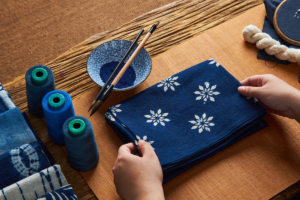
Japan’s rich cultural heritage is literally woven into the very fabric of everyday life, preserved by artisans dedicated to perfecting ancient techniques. But these traditional crafts are not frozen in time; they are living arts that seamlessly blend the centuries-old skills with modern design and global appeal.
From tatami mats that grace international fashion runways to handmade brushes that bring beloved anime to life, workshops across the country offer tours into the artistry of Japan you can discover at your own pace. Let’s explore the masterful worlds of tatami, shoji screens, washi paper, and traditional Japanese brushes—and how you can bring these authentic treasures into your own home.
Table of Contents:
- Traditional Japanese Tatami Creation
- Custom shoji screens and dividers
- Where to buy authentic washi paper
- Handmade Japanese calligraphy brushes
Traditional Japanese Tatami Creation
For centuries, the foundation of the Japanese home has been the tatami mat, prized for its natural aroma and elegant functionality. Today, pioneering workshops are taking this classic flooring to new heights.
Morita Tatami
Established in Japan’s capital city in 1933, Morita Tatami exports to 72 countries. Its igusa omote is used for the surface of the tatami mat. The natural grass is carefully woven into the mat, providing a nerve-calming aroma and undergoing sterilization to combat bacteria. Since 2000, Morita claims it holds the record for exporting over 860 times. Interestingly, Morita made and exported 300 tatami mats for Swedish fast-fashion house H&M for a Paris spring/summer collection in 2018. Their mats were also used in the 007 film No Time to Die (2021) starring Daniel Craig and Rami Malek.
Motoyama
While companies like Morita focus on global reach, maintaining the longevity of these mats requires specialized care. Motoyama steps in to handle the intricate repair process (tatami-gae), which is done in three main ways:
- Re-covering (omote-gae): Replacing the worn top layer with a fresh sheet.
- Turning over (uragaeshi): Flipping the worn top layer to reveal the fresh reverse side.
- Total Replacement: Swapping out the individual tatami as a whole.
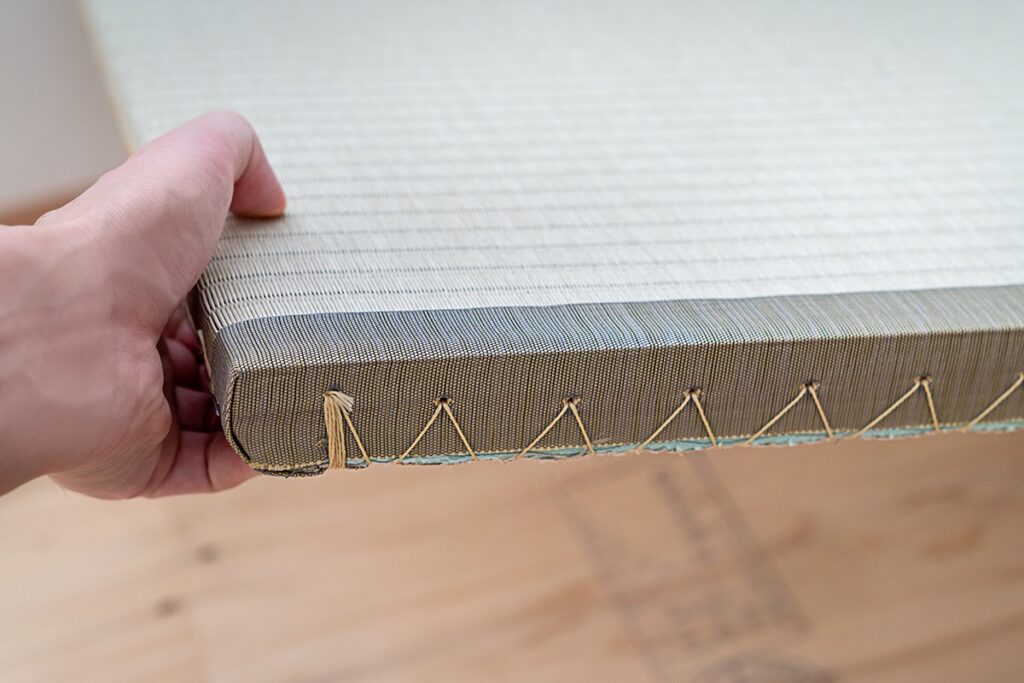
The core base of a tatami is called the toko, the woven top layer is the omote, and the fabric edge is the heri. Accurate measurements are key to ensuring the new tatami fits neatly without gaps. As a rule, the filling needs to be replaced about every 20 years, depending on the environment. Re-covering should be done about five years after an uragaeshi, and turning over a mat is recommended every three to five years after installation. Motoyama can ship its products all over Japan and worldwide.
Kenzie
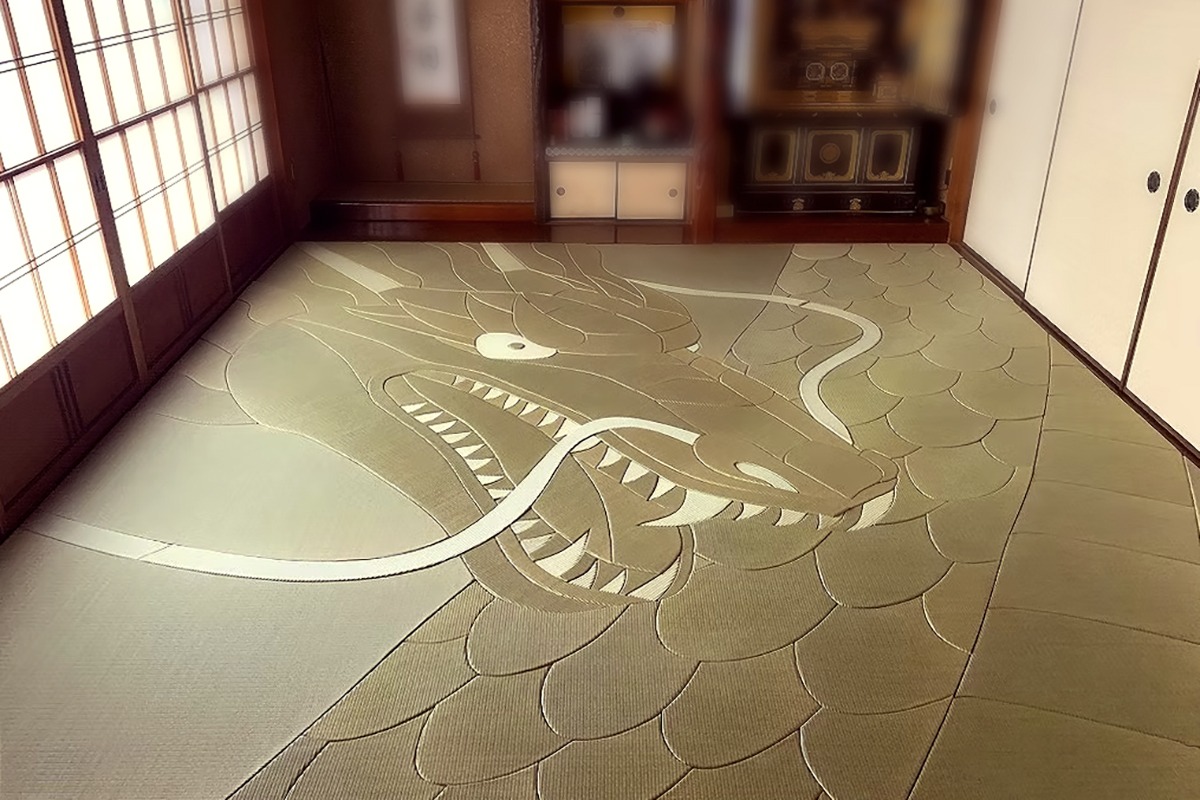
Beyond standard repairs, tatami can also serve as a canvas for striking artistic expression. Established in 1869 in Gifu Prefecture, Kenzie exports original tatami mats that combine Japanese tradition with art, making them highly recommended for event venues and museums. Kenzie uses color, unique weaving techniques, and unusual shapes to create one-of-a-kind designs.
Tokuratec
The precision required to craft these traditional and modern designs relies heavily on specialized equipment. Tokuratec, established in Okayama in 1961, develops the machinery that makes tatami. Their innovations include an all-automatic backstitch machine, a hot press rakutarou for neat whole-floor bonding (connecting the tatami face and back sheets), and a compact tatami mat knife grinder with built-in water cooling and a whetstone.
Tatamiser
Finally, bringing all these elements together for the modern consumer is Tatamiser. Based in Osaka, they deliver tatami for living rooms and oversee the entire process—from design and manufacturing to the sales of high-quality mats. Their offerings include specialized tatami flooring for babies. Blending traditional craftsmanship with modern technology, Tatamiser ensures products that are durable, functional, and aesthetically refined for homes, offices, and public spaces worldwide.
Custom shoji screens and dividers
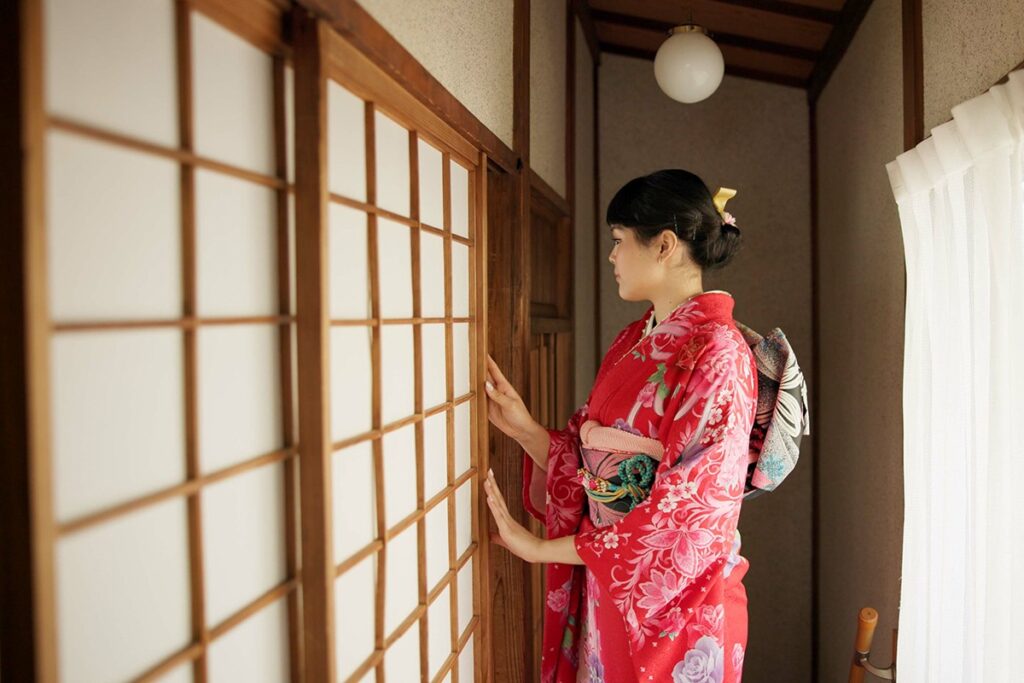
Moving from the floor to the walls, the soft, diffused light of a traditional Japanese room is achieved through shoji screens. These delicate wood and paper room dividers are constantly evolving to fit modern architecture.
Kitote (Nakai Sangyo)
Based in Wakayama Prefecture, Kitote produces made-to-order shoji (Ki stands for wood, while Te means hands). In its “Bold Line,” the lattice pieces feature uniform thickness and depth, creating a flatness that blends seamlessly with modern architecture. This line features a new type of shoji with a dual structure, combining vertical and horizontal latticework in the front and back for superior heat insulation.
Kitote’s “Slim Line” aspires to elegance by using a thinner wood (6 millimeters rather than the conventional 8 millimeters) to maximize the delicate latticework technique. Layout variations are extensive and include:
- Tome: Sound or edge
- Igeta: Patch or step
- Kiriko: Chess or flag
- Nuki: Sun or moon
- Gradation: Large or small
- Angle: Diamond or slash slim
- Asymmetry: Corner grid or slope
Bartok Design
While domestic companies push the boundaries of latticework, international designers are also captivated by shoji’s architectural potential. Founded by an Italian architect living in Kobe since 1998, Bartok Design builds custom shoji. Usually, shoji are made of sugi wood (Japanese fir), appreciated for its graphic grain and dimensional stability. Bartok can also build with hinoki wood (Japanese cypress), though the rice paper tends to detach more easily from it. Clients simply provide the net dimensions of their opening, and Bartok will dimension the four shoji with the correct overlapping. Traditionally, Japanese houses are based on a module of one-ken (1,818 millimeters).
RESTA
A shoji frame is nothing without its paper, and innovation is happening there as well. Based in Kobe, RESTA aims to provide an omotenashi (hospitality) spirit to the world through traditional shoji materials:
- Alistard: Excellent for moisture retention and thermal insulation, featuring billions of microscopic bubbles that block outside heat.
- Kirameki: A white-based paper featuring unique bumps and pieces of colorful Japanese paper.
- Mesh: A light-collecting paper that is thin, durable, and beautiful enough to be used as gift wrapping.
Where to buy authentic washi paper
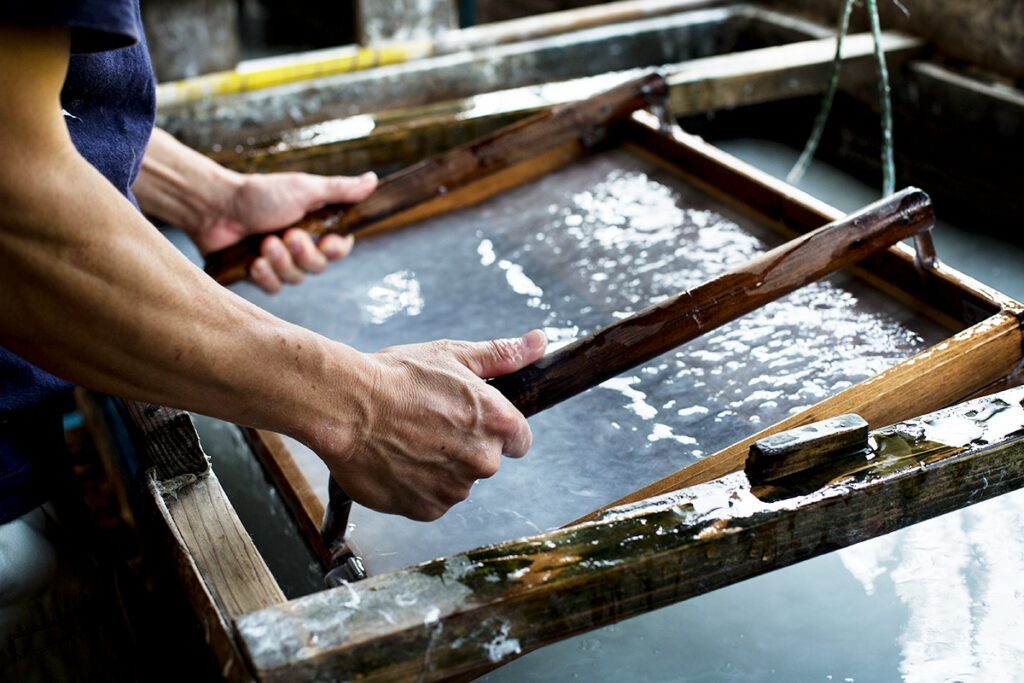
The paper used in shoji is just one application of washi, Japan’s incredibly durable and versatile handmade paper. Whether used for art, correspondence, or official documents, washi remains a regularly-seen cultural touchstone.
Watashino
Based in Tokyo’s Asakusa district, Watashino offers a hands-on washi paper-making experience, including tosa washi. Their colored paper plan allows visitors to create four postcards using rakusui (colored) paper. Because washi is said to withstand use for up to 100 years without tearing easily, Watashino highly recommends using its plain paper plan to create your marriage registration form.
Ozu Washi
To truly appreciate the history behind these papers, one must look to the long-standing institutions in Japan’s capital. Located in Tokyo’s cultural center, Nihombashi, Ozu Washi has been a purveyor of traditional paper since 1653. The Ozu Gallery serves as an exhibition space for paintings and paper art, while Ozu Cultural Classes cover calligraphy, Suiboku-ga (sumi art), and host a handmade washi experience studio. The craftsmanship of traditional Japanese handmade paper is so significant that it was registered on UNESCO’s Intangible Cultural Heritage of Humanity list in 2014.
Echizen
Stepping outside of Tokyo to the regional hubs of paper-making reveals even more specialized techniques. Founded in 1875 in Fukui Prefecture, Echizen makes large-format washi, modern washi, and various types of fusuma paper for sliding doors. Their repertoire includes the production of Torinoko paper—a lustrous, smooth paper with intricate texture used for woodblock printing and calligraphy. All of their colored and patterned washi is crafted entirely by hand.
Handmade Japanese calligraphy brushes
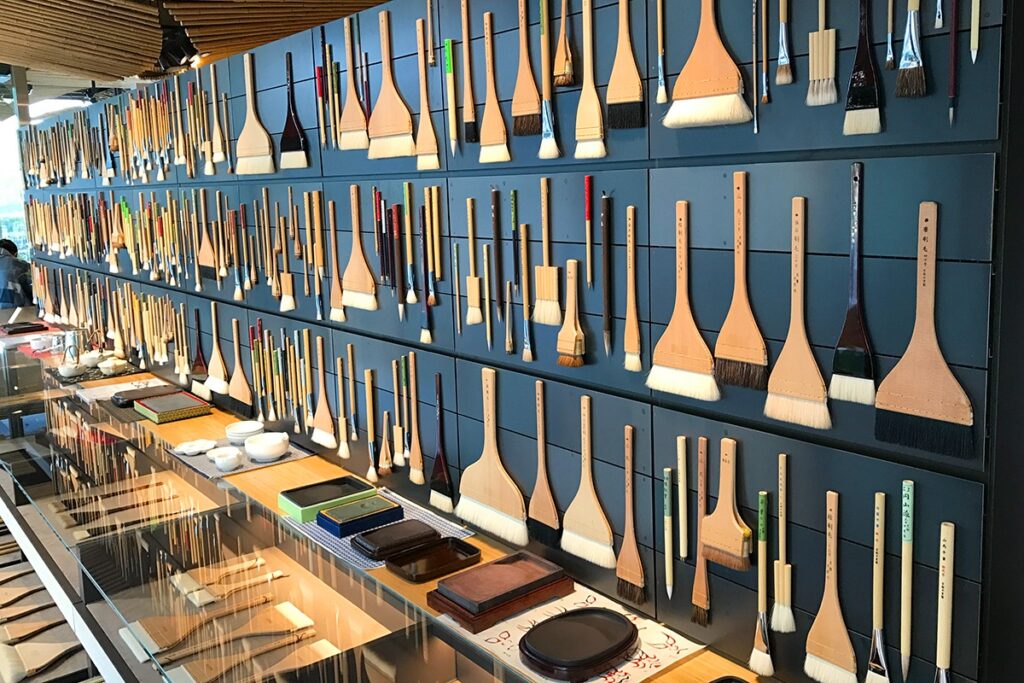
The smooth texture of washi paper naturally calls for the fluid strokes of a masterfully crafted brush. The art of fude (brush making) is deeply intertwined with Japan’s history of both fine art and modern media.
Hiroshima Artist Brush Manufacturing
Deeply involved in centuries-old arts, this company was rightfully established back in 1869. Along with calligraphy brushes and Japanese-style painting brushes, they produce Fudehime (handmade coloring brushes of Kumano), makeup brushes, and calligraphy paraphernalia. Hiroshima Artist also sponsors shodo (calligraphy) contests, including the Shodo Performance Awards in New York in 2025.
Shougetsudo
The demand for high-quality brushes extends far beyond traditional calligraphy, reaching into the modern entertainment that Japan is famous for. Operating since 1946 from Hiroshima, Shougetsudo produces 600 kinds of brushes, totaling 200,000 annually—all handmade by master craftsmen. Areas of expertise include Japanese-style painting, ink painting, animation background art, Sanskrit, and Yuzen dyeing. For line and fine painting, the Sokumyo and Sakuyo Fude are the most utilized, with the latter being thinner and stronger.
Notably, Shougetsudo’s Kumano Fude is recognized by the Japanese Ministry of Economy, Trade and Industry for their quality. In the 1990s, the art staff at Studio Ghibli noticed a decline in their usual brushes, which negatively impacted their background art. The studio turned to Kumano Town—which produces about 80% of all brushes in Japan—and consulted Shougetsudo to create the high-quality brushes needed for certified traditional anime.
Whether it is the calming scent of a freshly laid tatami mat, the soft light filtering through a shoji screen, the tactile strength of washi paper, or the precise stroke of a handmade fude brush, these crafts offer a tangible connection to Japanese history. You deserve to experience the beauty and depth of these arts, and bring the dedication and skill of the country’s finest experts directly into your life.
To stay updated on more insights about life in Japan, subscribe to the GoConnect newsletter.
If you enjoyed this article, please let us know and share your thoughts at hello@goconnect.jp.