

Why Japan’s Analog Classrooms May Be Its Edge in the AI Era
The most revealing trend in AI may not be what machines are learning, but what the people building them choose for their own children.
Steve Jobs limited his children’s screen time. Bill Gates withheld smartphones until 14. The Waldorf School of the Peninsula drew families from Apple, Google, Yahoo and Hewlett-Packard while keeping tablets out of its early classrooms. It now teaches coding, digital literacy and AI, but only after attention, curiosity and judgment are built.
It is not a controlled experiment. But why would the builders of our digital future limit their children’s exposure to it? And why are certain cognitive test scores declining in several developed countries? Japan offers a case study.
Curve That Bent
For most of the 20th century, intelligence test scores rose about three points a decade: the Flynn effect, after James Flynn, confirmed by a meta-analysis of nearly 300 samples. Better nutrition, schooling, public health and fewer toxins lifted each generation.
Then came the reverse Flynn effect. In 2018, Bernt Bratsberg and Ole Rogeberg examined more than 730,000 Norwegian conscripts born from 1962 to 1991. Scores peaked for men born around 1975, then fell roughly 0.2 points a year. Later-born brothers scored lower than older ones, which all but rules out genetics, immigration or fertility. What is left is the environment.
The Human Advantage Paradox
Population IQ rose for a century — then bent. 1975 was the turn.
Within-family conscript data, Norway 1962–1991 (Bratsberg & Rogeberg, PNAS 2018); corroborated in Denmark, the UK, France, Finland & the US.
Danish data on more than 1.5 million men peaked with the 1980 cohort. A review found reversals in seven countries, including the U.K., France and Finland. Among about 394,000 American adults, verbal and abstract reasoning fell at every education level, while spatial reasoning rose: minds adapting, not simply weakening.
So humanity is not becoming less intelligent; certain measured capabilities are changing. Let’s call the consequences the “Cognitive Recession” (a management metaphor, not a diagnosis): a gradual weakening of capabilities schools and businesses took for granted.
Thinking, Outsourced
The reversal starts with people born around 1975, long before smartphones or ChatGPT. Pocket calculators got to us first. We handed arithmetic to calculators, navigation to GPS and memory to search engines.
Researchers debate the causes: a ceiling on public health gains, changed schooling, deep reading giving way to fast screens, and what tests measure. Cognitive offloading is one contributor, not the whole explanation.
Generative AI goes further: It drafts, analyzes, proposes strategies, writes code and produces something close to a first judgment. It may prove the largest cognitive offloading event in history.
A 2025 Microsoft Research and Carnegie Mellon study of 319 knowledge workers found that the more confidence people had in AI output, the less critical-thinking effort they reported. A Massachusetts Institute of Technology Media Lab EEG study found weaker brain connectivity among people writing essays with AI; 83% could not quote a line they had just written. It is a small preprint: a signal, not a verdict.
Used to test conclusions, AI makes a professional more effective. Accepted without understanding, it gives faster results without judgment.
The tool is neutral. The choice isn’t.
Japan: The Country That Kept the Pencil
In PISA 2025, released Sept. 8, 2026, Japan ranked first in the OECD in science, mathematics and reading: 538, 525 and 503 against averages of 482, 463 and 461. It scored 557 in computational problem-solving, fourth worldwide and first in the OECD.
Meanwhile, OECD reading and mathematics hit record lows, with reading down 28 points since 2015. Students who skim and answer fast but wrong nearly doubled between 2018 and 2025; the OECD cited screen time and less reading for pleasure.
Students who almost never use AI to draft assignments scored 509 in science, against 481 for near-daily users. The OECD says this does not prove causation, and that moderate, intentional use may help. In Japan, 39% seldom or never use AI to research, draft or summarize, making it the only country above 30%.
Japan was not immune: Compared with 2022, it lost nine points in science, 11 in mathematics and 13 in reading, though the science and mathematics changes were not statistically significant. TIMSS 2023 corroborates its strength: Japan ranked in the top five in nearly all mathematics and science categories.
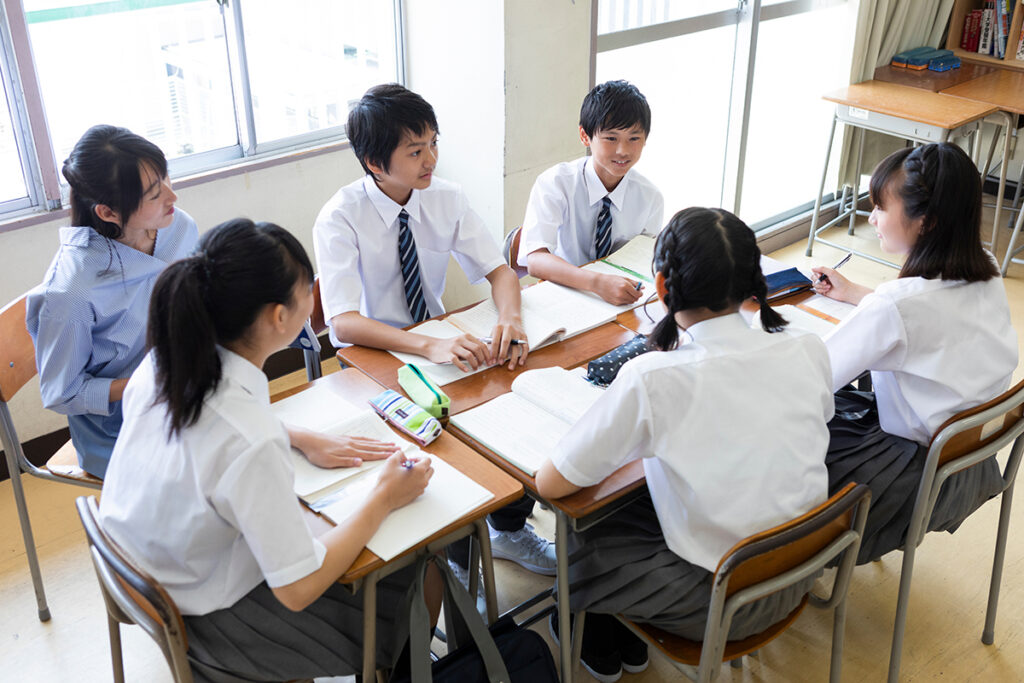
Part of the explanation may be what is sometimes called old-fashioned: traditional methods. Under the GIGA School program, completed in 2021, every student received a device. But the pencil survived. Children still learn kanji stroke by stroke, do mathematics on paper and keep handwritten notebooks that teachers inspect.
It digitized access. It did not digitize cognition.
Does the Medium Change the Mind?
A 2024 Norwegian University of Science and Technology experiment found more elaborate brain connectivity in handwriting than typing. A University of Tokyo study found paper-notebook users recorded information about 25% faster than tablet users, with stronger memory-related activation at recall. Meta-analyses found “screen inferiority” in certain reading tasks.
Care is needed: The Norwegian study tested only 36 students, and its methods were criticized. Paper does not always win. But the medium is not neutral.
In PISA 2022, about 5% of Japanese students were distracted by devices in most mathematics lessons, the OECD’s lowest (average about 30%); 18% were distracted by classmates’ devices, against 59%.
Handwriting is not proven to cause Japan’s results; culture, teacher training, family expectations, curriculum and supplementary schooling all count. But devices can coexist with traditional teaching.
Others are reassessing: Sweden committed 685 million Swedish kronor to printed textbooks in 2023 and 500 million kronor a year for 2024 and 2025; Denmark, Finland and the Netherlands moved to restrict school smartphones; and UNESCO cautioned that technology does not automatically improve learning.
The Waldorf Effect: Build the Human First
Japan is not a Waldorf system, yet both build the human first and add the machine later. Let’s call this “The Waldorf Effect”: handwriting before typing, mental calculation before automation, memory before search, deep reading before summaries and independent reasoning before AI answers.
A student who understands mathematics uses a calculator to go faster; a professional who knows a market uses AI to analyze more. Without foundations, the machine creates only an appearance of competence.
The order: analog foundations, digital mastery, AI augmentation. In that order, with the human engaged throughout.
The Human Advantage Paradox
What is abundant is cheap; what complements it gains value. As information becomes abundant, attention matters more; as answers do, telling correct from plausible; as content does, original thought; as machine intelligence does, judgment and wisdom.
Let’s call this “The Human Advantage Paradox”: The smarter our machines, the more valuable certain human capabilities may become. Not because AI cannot do sophisticated work, but because trust, responsibility and consequences stay with people.
Four areas show it: Trust (leadership, wealth management, mergers and acquisitions advisory, governance), care (medicine, eldercare, teaching, therapy, mentorship), craft (design, hospitality, trades, human authorship) and presence (negotiation, leadership in the room, live performance).
AI will transform all four, yet the human contribution may become the main differentiator. Markets will decide earnings. The claim is narrower: Human abilities that complement AI may command a growing premium.

What This Means for Business Leaders
If the Cognitive Recession is what decades of offloading look like, generative AI could be the accelerant. Advantage may come not from the most AI, which everyone will have, but from the strongest humans: people trained to think alongside AI. Three priorities:
- Reasoning before automation. Work from first principles before prompting. The friction is the learning.
- Challenge AI. Give teams analysis seeded with errors: Catching them is verifying; missing them is forwarding the machine.
- Reward thinking and responsibility: how well people assess answers, not how fast they produce them.
The future leader must know when AI’s answer is wrong, incomplete or inappropriate.
The Bottom Line: Keep the Human at the Center
The reverse Flynn effect began long before AI, so banning AI would not reverse it, and giving up its benefits would make little sense.
Protect instead the conditions in which intelligence develops: in schools, deep reading, handwriting, mental calculation and discussion alongside digital literacy; in business, people who question, synthesize and judge; in our own lives, ideas that remain our own, with AI as a complement, not a stand-in.
Japan is not a universal formula. But sometimes keeping a valuable practice is itself innovation. The organizations that prosper may be those that protect human thinking and make it stronger.
The goal is not to fight automation. It is to keep the human mind at the top of the operational stack and at the center of our lives.
That is the Human Advantage.