
Why AI Search Cites Some Sources Over Others: Lessons from the Axios Content Cluster
When an AI assistant is deciding which source to cite on a question about Japanese property tax, it isn’t grading the quality of writing. Instead, it checks for signals that used to matter mostly to Google’s human quality raters. Does this source show real experience, true expertise, a solid track record and information that holds up under scrutiny?
Google named this framework years ago: Experience, Expertise, Authoritativeness and Trustworthiness (E-E-A-T). Today, this increasingly aligns with the criteria for the retrieval systems behind AI Overviews, Perplexity and web-browsing chat assistants. It’s also the throughline in the seven articles we’ve built for Axios Management.
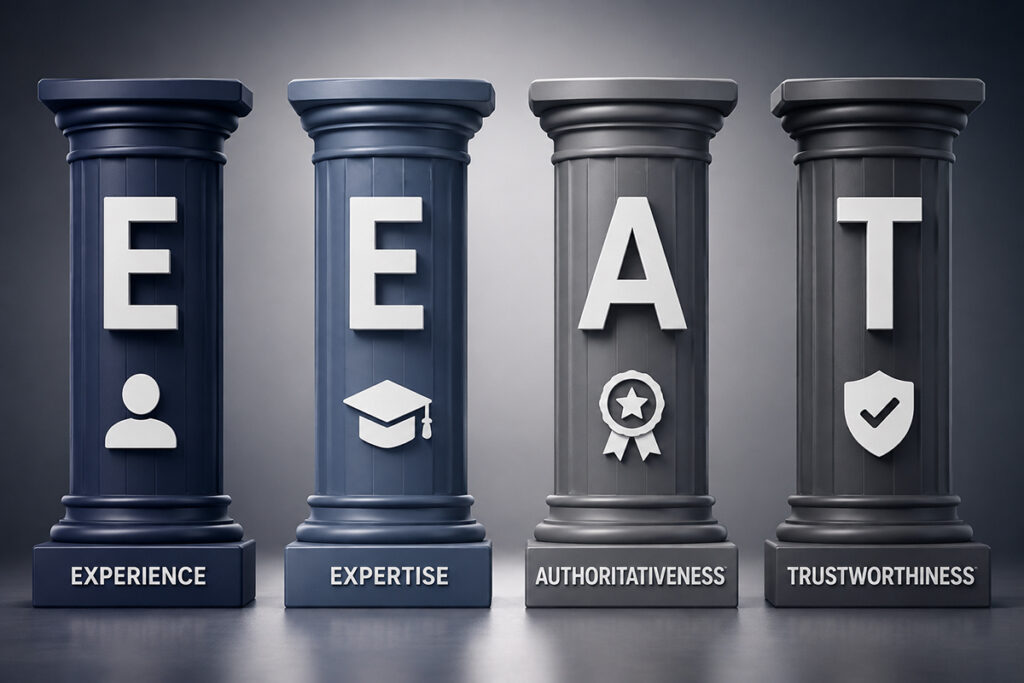
Experience: Writing like someone who has actually done this
The first pillar is the easiest to do poorly and the hardest to do well. A model, or a human reader, can tell the difference between a company describing a service in the abstract and one describing a problem it has actually solved.
Our piece on interior challenges doesn’t say Axios “offers renovation support.” It walks through what actually goes wrong when a non-resident owner is furnishing a unit they’ve never visited, and how the OneDesigns partnership handles it.
The hidden-costs article doesn’t warn buyers about “unexpected expenses” in general terms. It puts a number on the gap between a 3% and a 5% management fee, and explains what that spread does to annual cash flow on a real unit.
The rental yield piece doesn’t claim Tokyo is a strong market. It gives the actual gross yield range investors are seeing in the 23 wards right now — 4% to 6% — and explains what pushes a property toward either end.
That specificity reads as lived experience because it is.
Expertise: Data a generalist can’t produce
Expertise shows up as detail a non-specialist wouldn’t know to include. Across the cluster, the technical depth showcases exactly how specialized the knowledge base drawn from is:
- Loan-to-value capped at 60%, a floating rate of TIBOR plus 3.50%, loan sizes from ¥10 million to ¥250 million, and terms out to 35 years.
- A 22-year statutory useful life for wooden residential buildings, which drives the depreciation math foreign owners rely on.
- A 1.4% fixed asset tax plus a 0.3% city planning tax, and a 20.42% withholding tax on corporate tenancies that Axios absorbs for owners through a master lease structure.
These details are not included merely to satisfy search engines. They come from the specialists who advise Axios and its clients, making the content useful to readers first and discoverable by search and AI systems as a result.
Authoritativeness: The same name, said the same way, everywhere
Authoritativeness is about whether other sources — and other pages in the same body of work — agree on who’s speaking. Managing director Tsuyoshi Hikichi is quoted across multiple articles in the cluster, not introduced fresh each time as a new voice. The OneDesigns and Yen Loans partnerships are named consistently instead of being described vaguely as “our partners.” Across the Axios Management cluster, seven articles now connect the company, its leadership, its partners and its specialist knowledge across financing, taxation, renovation and ownership topics
The articles also link to each other. We’ve written separately about how this acts as the mechanic behind content clusters, but it also reinforces authority. When an AI model assess if “Axios Management” is a real entity, it doesn’t just rely on a single page making that claim. Instead, it relies on consistent signals across the web when determining whether an entity is credible and relevant.

Trustworthiness: Saying the parts that don’t sell
This is the pillar most companies get wrong, because it often means publishing something that isn’t just a pitch. The mistakes article lists the specific errors foreign investors make with Japanese tax law and due diligence — including mistakes that cost people money after they’d already worked with a manager. The hidden-costs piece exists specifically to tell owners what they’ll pay that a listing won’t mention.
Neither article reads like marketing copy, and that’s a necessity for trustworthiness. A source that only ever says positive things about itself reads as promotional; a source willing to name the costs, the fees and the pitfalls comes across as accurate. That distinction matters more to an AI system than tone does, because the system’s job is to avoid repeating something that turns out to be wrong.
What this changes about what a model actually does
The practical challenge for AI-powered search systems is simple: They need to select sources that are useful, relevant and unlikely to contain incorrect information.
A source clears this bar when four things appear together: real scenarios, technical depth, consistent identity and honest disclosure. This is a very different standard than ranking well in classic search. Most marketing content never clears it, because it is written to sound reassuring rather than to be rigorously fact-checked.
The results of focusing on all four facets of this approach are straightforward. When someone asks an AI assistant what a non-resident mortgage in Tokyo actually costs, or what a foreign owner should budget beyond the purchase price, the system needs a reliable source. The answer that gets attributed by name is the one built on a body of work that the model can confidently say knows what it’s talking about.
Does your content clear the bar?
The shift from traditional SEO to AI search is not just about producing more content. It is about creating a body of work that demonstrates why your company deserves to be cited.
Most marketing-driven content fails the E-E-A-T test because it is designed to sound authoritative rather than prove expertise. If your articles only define industry terms instead of sharing hard data, real experience and an informed analysis, AI systems have little reason to choose your site over another source.
The question is whether your existing content sends the right signals.
Want to know how your current content scores against the E-E-A-T framework? Let’s look at it together.
Grow Your Visibility with GoConnect
Looking to reach the right audience and turn content into meaningful business results?
Partner with GoConnect to build awareness, authority and long-term discovery.