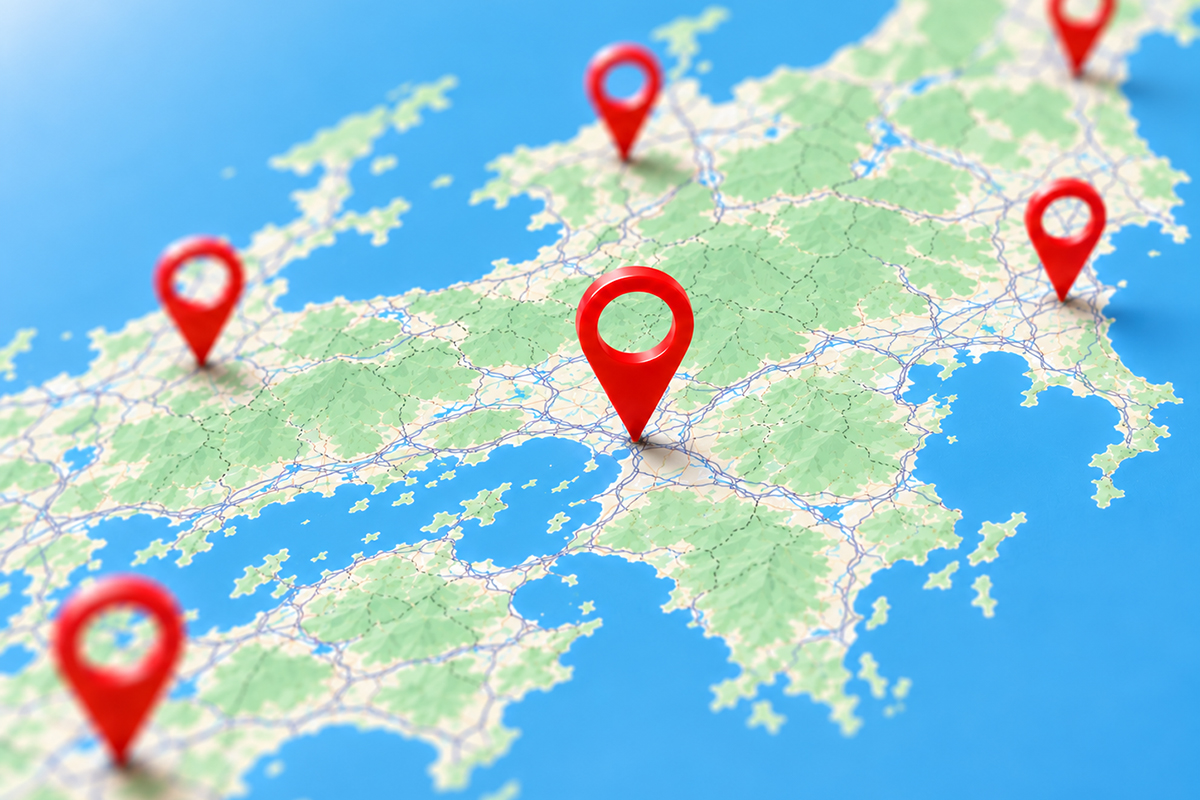
Tokyo isn’t Japan: Why Geographic Targeting Can Make or Break Your Campaign
In Japan, geographic targeting matters more when your customers are English-speaking residents. Why? Because that audience is small and concentrated. The Immigration Services Agency counted 4,125,395 foreign residents at the end of 2025, roughly 3% of the population. National statistics and our own campaigns point the same way. But why does that matter to an advertiser?
Where English-speaking residents live
Japan does not publish a count of English speakers, so nationality is the closest proxy. It has limits, because many English speakers hold other passports, but the pattern is still useful to consider.
Starting with all foreign residents: Tokyo had 801,438 at the end of 2025, or 19.4% of the national total, followed by Osaka with 375,319, Aichi with 357,800 and Kanagawa with 317,353. That leaves more than 80% of foreign residents outside Tokyo. Osaka’s count also grew 12.5% in a year, against 8.5% for Tokyo. The top five prefectures hold roughly 52% of the total, so about half live in five places and the rest are spread across the other 42.
Narrowing down to British residents shows the same pattern. Of 22,428 living in Japan in December 2025, 7,689 were in Tokyo, 2,012 in Kanagawa, 1,748 in Hokkaido and 1,405 in Osaka.

What GoConnect’s campaigns show
GoConnect readers are primarily based in Tokyo, and our top-performing advertiser categories are education, real estate, luxury lifestyle, wellness, travel and professional services. That gives Tokyo advertisers a natural fit and means conversations with advertisers elsewhere have to start with us exploring a geographically targeted plan.
This is since our categories depend on a physical location, and an English-speaking parent in Tokyo has little use for a school in Osaka. Without good geographic targeting, a piece of content or campaign may collect views, but they will not be from an audience that can use the service. Our audience is already small, so every reader sent to the wrong city is a more significant waste of resources.
Our Grand Hyatt Tokyo giveaway shows how effective a well targeted campaign can be. The prize was two tickets to an Aug. 15 party in Roppongi Hills. From July 13 to Aug. 7, the landing page drew 1,108 views and converted at 7.3%, producing 81 entries. The newsletter banner sent 59 clicks to the entry page, and 32 visitors went on to the hotel’s booking page, a 2.9% click-through rate — a strong click-through rate for a display advert. Those clicks came from readers close enough to the venue to consider going.
With this in place, every entrant was now telling us something vital without us asking: They were based in Tokyo, interested in premium events and comfortable reading English. That is the profile hospitality and events partners look for, and one we could report back to the Grand Hyatt Tokyo.
The Gold-Guide campaign needed the opposite approach. Its subject was a tea salon near Osaka Castle, so the Meta campaign was targeted by audience, placement and geography. It reached 19,857 people and produced 2,837 page views. Visitors to our connected article averaged 4 minutes, 37 seconds on an article with a reading time of about seven minutes. While the Meta campaign was a further cost, it meant each of those page views was far more likely to be a conversion — and the engagement rate and time proved it a sound investment.

How to target English-speaking residents by location
So, here are our top three steps to keep a campaign aimed correctly:
- Match the offer to the audience’s location. A Tokyo venue suits GoConnect’s newsletter. A business in Osaka, Okinawa or Hokkaido needs paid social with a geographic filter, as Gold-Guide had.
- Go beyond the city prefecture. For Tokyo, plan by ward or station area, rather than the entire metropolitan area.
- Check location reports mid-campaign. Meta and Google Analytics both show where clicks come from, while there is still time to adjust — take that data and make changes.
English-speaking residents are a small audience, and a small audience leaves little room for wasted reach. Businesses that want to reach them in a specific city or ward can partner with GoConnect to build a campaign around where they live.